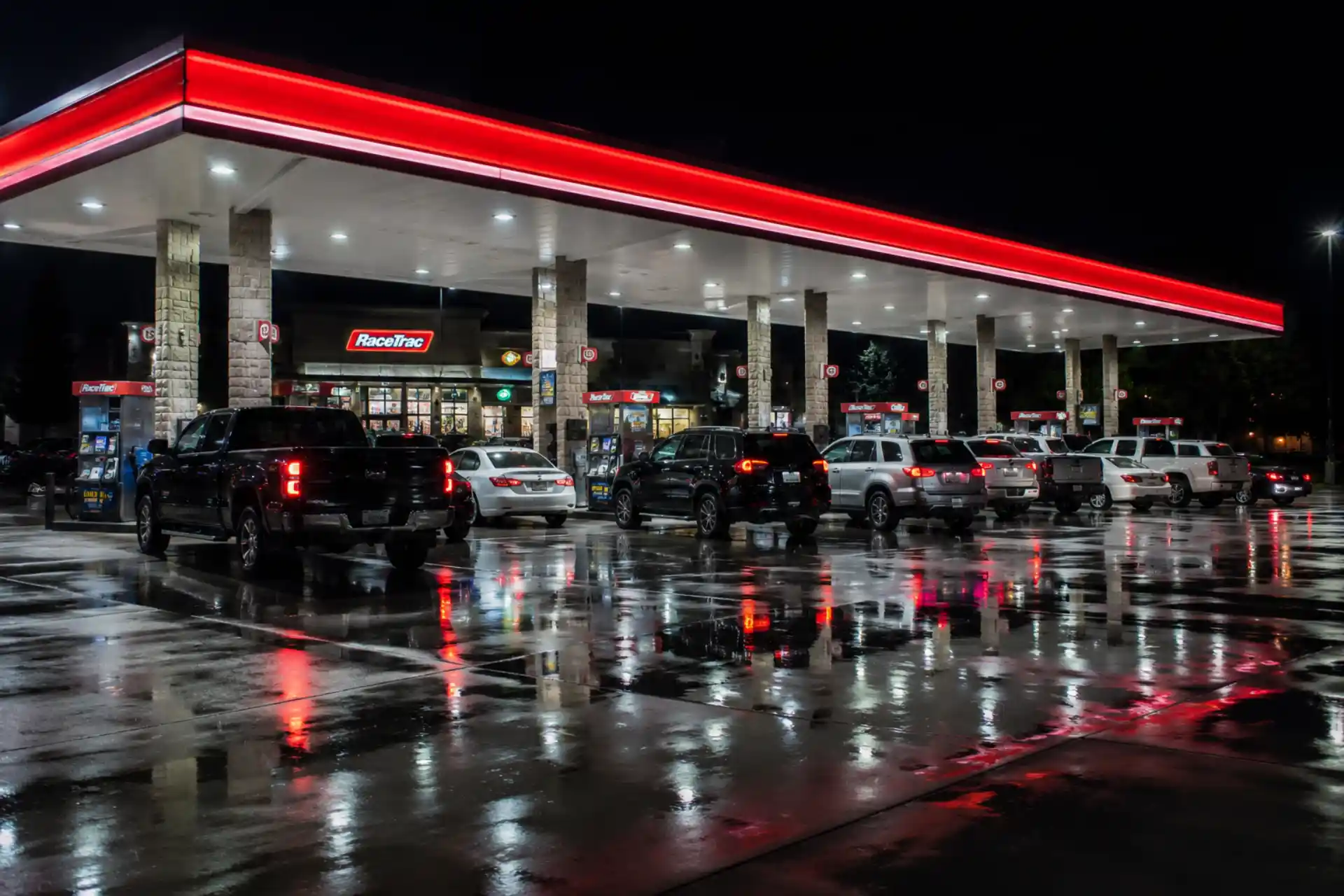
Most new gas station and convenience store projects cost between $1.5 million and $6 million to build, not including land — with small-format stores at the low end and larger builds with car washes or expanded food service pushing toward the high end. Travel centers and truck stops are a different category entirely, typically running $8 million to $15 million or more. The number that matters for your project depends heavily on site size, fuel system scope, and building specifications — which is exactly what a site feasibility study is built to pin down before you commit capital.
Here’s how those costs break down.
Construction Costs by Format
| FORMAT | TYPICAL BUILD COST* | WHAT’S INCLUDED |
| Small-format c-store | $1.5M – $3M | 2,500–3,500 SF store, 4 fuel dispensers, standard canopy |
Mid-size c-store | $3M – $6M | Larger store, 6–8 dispensers, often includes car wash or expanded food service |
Travel center / truck stop | $8M – $15M+ | Multiple diesel lanes, expanded parking, driver amenities, food service |
*Excludes land acquisition, which varies too widely by market to generalize — see below.
What Actually Drives the Cost
The fuel system, not the building, is usually the biggest expense. Underground storage tanks, dispensers, piping, vapor recovery systems, leak detection, and the reinforced concrete forecourt form a cost center that frequently rivals or exceeds the convenience store building itself — and it carries the heaviest environmental compliance and permitting burden on the whole project.
Building and canopy construction typically runs $150–$350 per square foot, though this climbs with higher-end interior finishes, an integrated food service kitchen, or a car wash tunnel. A basic fuel canopy alone generally costs $75,000–$300,000, depending on size, site preparation needs, and fire suppression requirements.
Land is the wildcard. A high-traffic corner lot in a growing metro can cost many multiples of rural highway frontage — this is almost always the least predictable line item, and it’s why land cost is quoted separately from construction cost industry-wide.
Soft costs add up fast. Environmental site assessments, permitting, engineering and architectural design, and utility hookups are easy to underestimate and can meaningfully change the total project budget.
Travel Centers Are a Different Category
A travel center or truck stop isn’t just a bigger gas station — it’s a different build entirely. Diesel lanes, expanded parking for commercial trucks, driver amenities, and larger food service operations push total project costs into the $8–$15 million range, with the largest full-service travel plazas exceeding $20 million. If you’re evaluating a travel center site, cost estimation depends even more heavily on projected diesel volume and highway access than a standard c-store does.
What Can Push Your Number Higher or Lower
- Underground storage tank count and capacity — more tanks, more dispensers, higher fuel volume capacity all add cost
- Environmental conditions — soil remediation or contamination findings can add significant unplanned cost
- Regional labor and material costs — construction costs can swing 20–40% by region
- Site complexity — grading, drainage, and access requirements vary a lot by lot
- Add-ons — a car wash, expanded food service, or a larger convenience store footprint all add meaningfully to the total
Timeline
Most projects run 9–15 months from site prep to opening, depending on permitting timelines, environmental review, and equipment lead times.
Why This Is Where a Feasibility Study Pays for Itself
Construction cost is only half the equation — the real question is whether a given site can generate enough fuel and merchandise sales to justify that investment. A site feasibility study pressure-tests your specific location against traffic counts, competition, and demographics before you’re locked into a construction budget, so you’re sizing the project to what the site can actually support rather than a generic industry range.