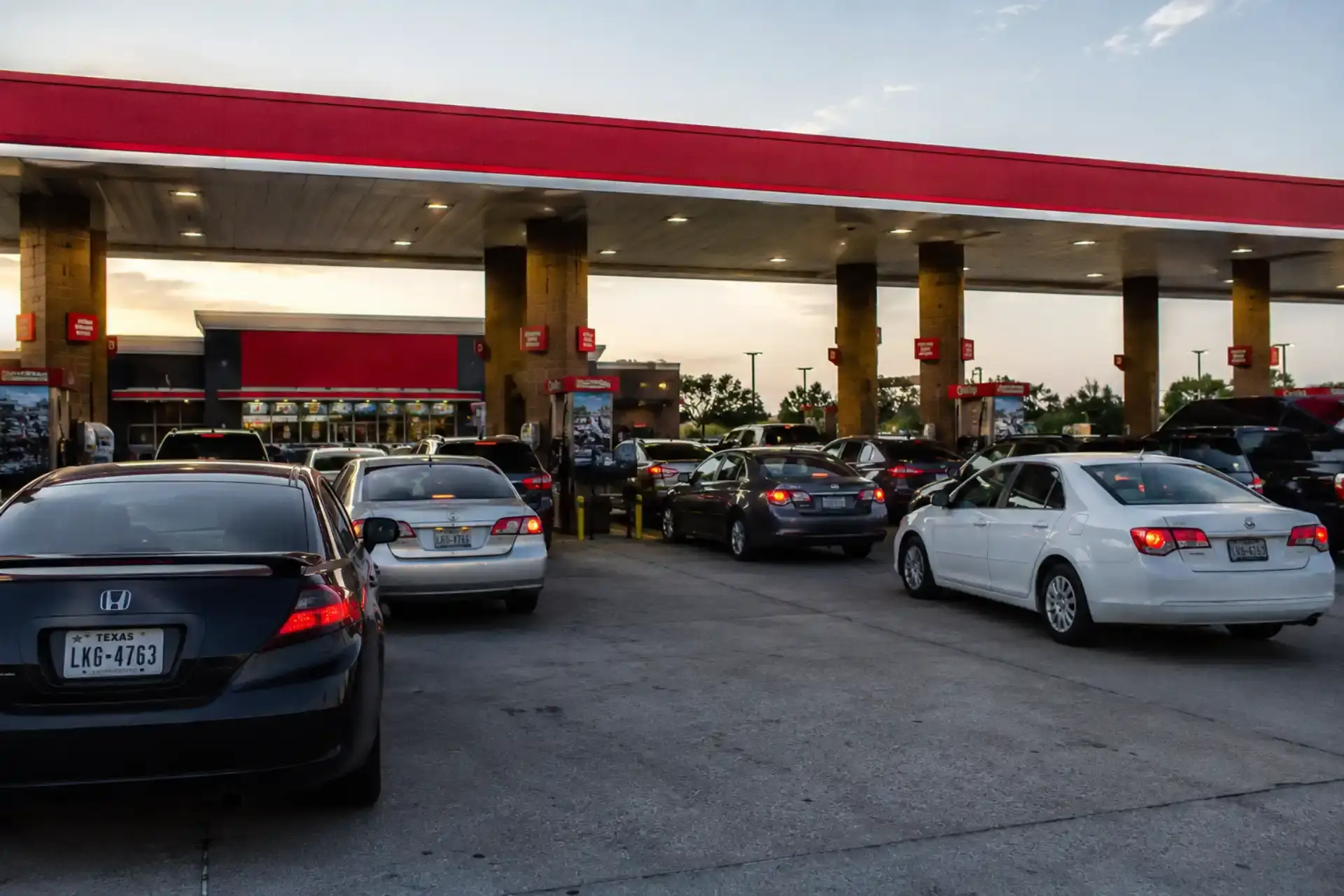
Fuel is a low-margin, high-volume business — net margins on gasoline sales typically run just 1–3%. The convenience store is where the real profit lives, with merchandise gross margins commonly landing in the 30–45% range depending on the category. For new development, most investors target an internal rate of return (IRR) in the 12–25% range, with ground-up construction projects generally underwritten toward the higher end of that range to compensate for construction and lease-up risk. Here’s how those numbers actually break down.
Fuel Margins: Thin by Design
Fuel margin is measured in cents per gallon rather than as a clean percentage, and it compresses fast when crude prices spike or a competitor undercuts the street price nearby. Even in a strong margin environment, net profit on fuel sales alone typically lands around 1–3% — which is why fuel is best understood as a traffic driver, not a profit center. It gets the vehicle onto the lot; the convenience store is what turns that visit into meaningful profit.
Where the Profit Actually Comes From
Convenience store merchandise carries dramatically higher margins than fuel — often ten to twenty times higher on a percentage basis.
| CATEGORY | TYPICAL GROSS MARGIN |
| Fuel | 1–3% net |
| Packaged beverages | ~30%+ |
| Snacks & candy | ~30%+ |
| Prepared food / foodservice | 30–45% |
| Coffee & fountain drinks | High margin, fastest-growing category |
| Tobacco | Thin margin, but high transaction volume |
The structural reality of this business: inside sales typically account for only around 30% of total revenue, but roughly 70% of total gross profit. A site that can’t support a strong in-store offering — food service, a well-merchandised store, adequate parking for a quick stop — is competing at a real disadvantage, regardless of how much fuel volume it does.
What IRR Should You Target?
Target IRR depends heavily on risk profile. As a general real estate development benchmark, opportunistic ground-up projects are typically underwritten to a 12–18% IRR, and retail development specifically often targets 15–25% IRR over a 3–5 year hold to compensate for construction, permitting, and lease-up risk. Where a specific fuel or c-store project lands in that range depends on:
- Site quality — traffic counts, access, and visibility directly affect achievable sales volume, which drives the return
- Construction cost relative to projected revenue — a site with high build cost but average sales potential compresses IRR fast
- Financing structure — debt terms, equity requirements, and DSCR (debt service coverage ratio) requirements from your lender all affect the return equation
- Add-on revenue streams — a car wash, food service program, or strong merchandise mix all lift the blended return relative to a bare-bones fuel-only site
How Operators Value an Existing Station
For acquisitions of an already-operating site (rather than ground-up development), valuation typically runs on EBITDA or SDE (seller’s discretionary earnings) multiples, commonly in the 3x–4.5x range depending on earnings stability, lease terms, and growth trajectory — with car wash, strong food service, or multi-unit portfolios often commanding the higher end.
Why This Is a Site-Specific Question, Not a Rule of Thumb
Every number above is an industry range — the actual margin and return for your project depends on the specific site: the traffic it can capture, the competition it faces, the construction cost of the specific lot, and the merchandise mix it can realistically support. That’s exactly what a feasibility study is built to model before you commit capital, rather than relying on industry averages that may not reflect your market.
Get a Free Site Feasibility Consultation
Got Questions?
Frequently Asked Questions
About Gas Station & C-Store Profit Margins
What profit margin does a gas station make on fuel?
Net margin on fuel sales typically runs 1–3%. Fuel is priced to drive traffic to the site, not to generate the bulk of the profit.
What profit margin does the convenience store make?
Convenience store merchandise typically carries 30–45% gross margins depending on category, with prepared food and coffee among the highest-margin and fastest-growing segments.
What IRR should I target for a new gas station or c-store development?
Ground-up retail development is generally underwritten to a 15–25% IRR to compensate for construction and lease-up risk, though the achievable return for a specific project depends heavily on site quality and construction cost.
How is an existing gas station valued?
Most operating stations are valued using EBITDA or SDE multiples, typically in the 3x–4.5x range, with stronger multiples going to sites with car washes, strong food service, or stable multi-year earnings.
Why does the convenience store matter more than the fuel volume?
Because inside sales typically generate roughly 70% of total gross profit despite representing only about 30% of revenue — a site that can’t support a strong in-store offering is structurally disadvantaged even with solid fuel volume.